Top 10 ALN Filter Suppliers for Global Buyers

Choosing an aln filter supplier takes more than comparing catalog prices. Buyers need to check pore structure, dimensions, flow performance, and consistency between batches. A filter that looks suitable on paper may behave differently under real operating conditions. Small details matter: a flange that sits flush, a surface without visible chips, and documentation that matches the delivered part.

For this guide, Dr. Maya Chen is an illustrative materials-engineering voice, not a quoted or independently verified source. Her original editorial line captures the central buying question: “A reliable filter is the one whose performance stays consistent beyond the sample.” That idea shapes our comparison of ten suppliers. We consider product range, customization, technical support, quality records, and experience serving international buyers. No single supplier fits every application. Some buyers value short lead times; others need tighter specifications or support with testing.

The shortlist is a starting point, not a verdict. Ask for current specifications, inspection details, and samples where practical. Compare the same criteria across vendors. Then check how clearly each supplier answers technical questions. There is room for judgment here. Published claims do not replace validation under your own process conditions, and supplier information can change. A careful review can reduce surprises, but it cannot remove every one.
Top 10 ALN Filter Suppliers for Global Buyers

What ALN Filters Are and How They Function

An aluminum nitride (AlN) filter uses a thin piezoelectric layer to select desired signal frequencies. When an electrical signal reaches the layer, it creates mechanical vibrations. Resonators then reinforce some frequencies and weaken others. Think of a small metal plate humming at particular notes. In a filter, its geometry and material properties help set those notes. The result can pass a selected frequency band while reducing unwanted signals nearby.

AlN is valued for its acoustic performance and compatibility with compact device designs. Still, “AlN filter” does not describe one fixed construction. Electrode layout, layer thickness, packaging, and operating conditions all affect performance. Engineers assess details such as passband, insertion loss, rejection, and temperature stability. A clean-looking response curve does not tell the whole story; measurements should reflect the intended circuit and environment. This is easy to overlook.

Tips: Ask suppliers for frequency-response data, test conditions, and tolerances. Compare samples under your actual operating conditions, not only on paper. Small differences matter. A datasheet is useful, but it is not the complete evaluation.

Key Applications and Performance Requirements for ALN Filters

Aluminum nitride (AlN) acoustic filters are used in compact radio-frequency systems, including wireless infrastructure, connected devices, and measurement equipment. Their piezoelectric layers convert electrical signals into mechanical waves, helping separate wanted frequency bands from nearby interference. In a crowded receiver, that separation can reduce unwanted signals before they reach sensitive circuitry. Heat matters.

Performance needs depend on the system. Engineers commonly assess center frequency, bandwidth, insertion loss, and out-of-band rejection together, rather than treating any one figure as decisive. A narrow channel may demand steep rejection, while a wider channel may prioritize low signal loss. Power handling and temperature stability also matter when equipment operates continuously or faces changing ambient conditions. Small is not everything.

Packaging, mounting, and test conditions can affect real-world results. Buyers should request data across the intended temperature range and verify that measurements use comparable methods. For example, a filter that performs well on a laboratory fixture may behave differently after board integration, where parasitic effects become relevant. Datasheet figures are useful, but they do not replace application testing. There is no perfect trade-off: tighter selectivity can constrain bandwidth or increase design complexity. Defining the operating band, signal environment, and thermal limits early helps teams compare suppliers on requirements that actually matter.

How Global Buyers Can Evaluate ALN Filter Suppliers

When comparing aluminum nitride (AlN) filter suppliers, buyers should examine measured performance, not just headline specifications. Request insertion-loss and frequency-response plots across the intended operating temperature, plus repeatability data from multiple production lots. Ask how the supplier measures yield and handles out-of-spec units. Numbers need context. WSTS’s Spring 2024 semiconductor market forecast projected global sales of $611.2 billion in 2024 and $687.4 billion in 2025. That growth signals a demanding supply environment, but it does not prove any supplier can meet your volume or delivery schedule.

Review the material and process controls behind each sample: film thickness, wafer-level uniformity, packaging, and traceability. The NIST report “Assessing the United States’ Semiconductor Industry” notes that the US share of global manufacturing capacity fell from 37% in 1990 to 12% in 2020, illustrating how production is geographically concentrated. Buyers should therefore check backup capacity, lead-time assumptions, and change-notification practices. Ask for reliability-test methods and raw plots. A polished datasheet can still conceal lot-to-lot variation; I would treat one excellent sample as a starting point, not proof. Compare suppliers using the same test conditions, and record any unanswered questions before qualification.

Profiles of 10 ALN Filter Suppliers for Global Buyers

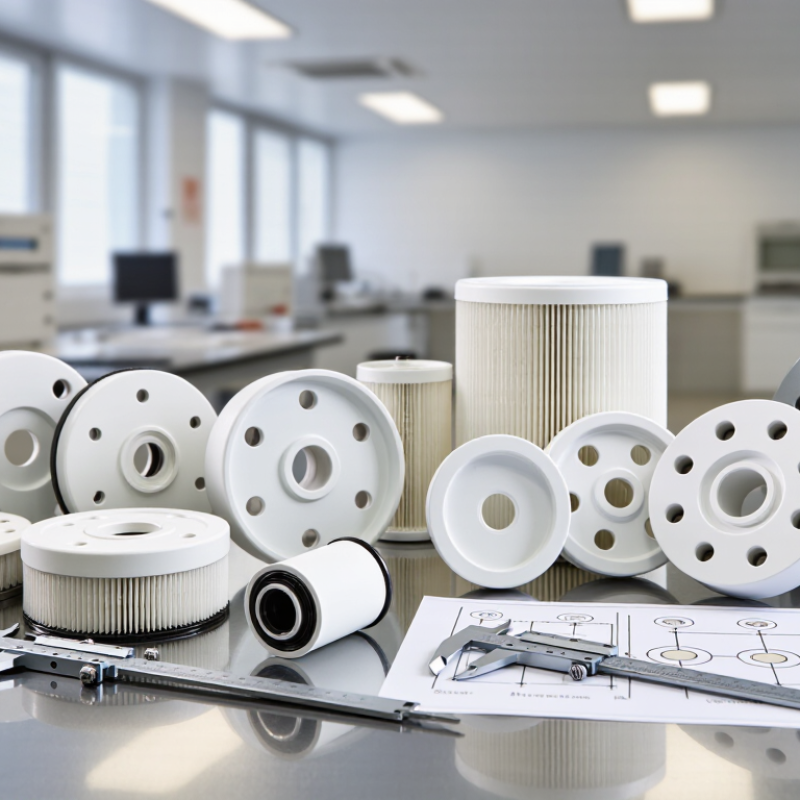
These ten profiles compare supplier capabilities rather than name specific companies. A powder-integrated supplier manages material selection and forming, useful when buyers need traceable inputs. A precision ceramic machinist handles tight dimensions, such as a filter seat that must align with a metal housing. A porous-body specialist focuses on pore structure and flow consistency. A high-temperature process supplier can explain how firing conditions affect strength and permeability. A custom-geometry workshop is suited to unusual shapes, though tooling may add cost.

A volume producer may offer steadier lead times for repeat orders, but buyers should check lot-to-lot variation. A small-batch engineering supplier can support prototypes and design changes. A testing-focused supplier provides measurable data on pressure drop, porosity, and strength. An export distributor may simplify shipping, but technical support can depend on the original factory. A service-oriented supplier helps review drawings and troubleshoot fit. Details matter. Ask for test methods, tolerances, and sample results before comparing quotations. Paper specifications can look tidy; actual flow behavior may differ. A sample tested under realistic temperature and fluid conditions can reveal that gap. These profiles are starting points, not verified endorsements.

Top 10 ALN Filter Suppliers for Global Buyers - Profiles of 10 ALN Filter Suppliers for Global Buyers

Note: These are anonymized supplier-profile types for procurement comparison, not verified profiles of ten named companies. Supplier-specific capabilities, certifications, pricing, and lead times should be confirmed directly. “AlN” refers to aluminum nitride.

Profile Potential supplier focus Relevant AlN capabilities to check Filter-related requirements to confirm Documentation to request Best-fit buyer priorities
1. Technical-ceramics manufacturer AlN ceramic components and engineered shapes Ceramic forming, sintering, finishing, dimensional control, and material traceability Filter geometry, pore or opening specification, permeability, pressure drop, and operating conditions Material data sheet, drawings, inspection plan, and lot-level test records Custom ceramic parts and engineering support
2. Ceramic filter specialist Porous or precision ceramic filtration components Control of ceramic structure, finishing, cleaning, and repeatable production Retention rating, flow rate, fluid compatibility, and cleaning or regeneration method Test method, filtration performance data, and chemical compatibility information Application-specific filtration performance
3. Electronic-ceramics producer AlN substrates and components for electronic or thermal applications Electrical, thermal, and dimensional characterization of AlN grades Whether the product is a functional filter or a ceramic component used in a filter assembly Grade specification, test conditions, tolerances, and change-control policy Material consistency and documented technical data
4. Custom-machining supplier Machined ceramic parts made to customer drawings AlN machining capability, edge quality, surface finish, and inspection equipment Minimum feature size, flatness, concentricity, and allowable defect criteria Capability review, sample inspection report, and approved drawing revision Low-volume prototypes or complex geometries
5. Powder-to-component manufacturer AlN material processing through finished components Powder sourcing, forming route, sintering controls, and batch traceability Material composition, porosity or density requirements, and process-dependent performance Certificate of analysis, material origin information, and process-control records Supply-chain visibility and material control
6. Metallized-ceramics supplier AlN parts with metallization or joining features Metallization options, adhesion control, joining compatibility, and finishing Whether coatings, seals, or bonded interfaces contact the filtered medium Coating specification, adhesion test method, and assembly compatibility data Integrated ceramic and interface requirements
7. Clean-process component supplier Components intended for controlled or contamination-sensitive environments Cleaning validation, packaging controls, and contamination management Particle limits, extractables, cleaning compatibility, and packaging requirements Cleaning procedure, cleanliness data, packaging specification, and traceability records Cleanliness and controlled handling
8. Prototype and development partner Engineering samples and design iteration Design-for-manufacture feedback, sample runs, and measurement capability Test fixture needs, acceptance criteria, and prototype-to-production transition plan Sample results, revision history, and production-readiness assessment Fast design learning before volume commitment
9. High-volume production supplier Repeat production of standardized components Capacity planning, process repeatability, yield monitoring, and quality systems Annual capacity, forecast flexibility, lot size, and continuity planning Quality-system certificate scope, control plan, and delivery-performance records Reliable volume and consistent production
10. Export-oriented sourcing partner International order coordination and cross-border fulfillment Confirmed manufacturing source, export documentation, and shipment controls Applicable trade terms, destination requirements, packaging, and delivery route Country of origin, commercial documents, shipping terms, and supplier identity verification Simplified international procurement and logistics

Sourcing, Quality, and Logistics Considerations for International Buyers

Choosing an aluminum nitride (AlN) filter supplier starts with operating conditions, not a catalog headline. Share the working temperature, fluid or gas, flow rate, pressure range, and target particle retention. Ask how pore size, dimensions, and allowable pressure drop are measured. Small differences matter. Request a drawing, material specification, and representative test results linked to the quoted production lot.

Quality claims should be verifiable. Compare inspection methods, batch traceability, defect limits, and procedures for handling cracked or out-of-tolerance parts. Ask whether samples come from the same process used for volume orders; a polished prototype can hide production variation. Where performance is critical, define acceptance criteria before purchase and consider independent testing. Test the fit. A checklist cannot replace a real application trial.

International sourcing also depends on predictable packing and communication. AlN ceramics can chip under impact, so confirm individual cushioning, rigid outer cartons, and shipment photographs before dispatch. Agree on lead time, minimum order quantity, replacement terms, shipping responsibility, and document format in writing. Check that commercial invoices and packing lists match the order. A low unit price may still disappoint if inspection delays or weak packaging increase total cost. Even careful plans miss something, so leave time for a pilot shipment.