
Top Double Male Luer Lock Adapter Suppliers Worldwide?
Choosing the right double male luer lock adapter requires more than comparing prices. Buyers must examine thread accuracy, material quality, leakage resistance, sterilization compatibility, and production consistency. A small connector can affect an entire fluid pathway. That detail is easy to overlook.
Dr. Elena Marquez, a medical-device connector specialist, explains, “Reliable luer performance begins with verified dimensions, controlled molding, and testing under real handling conditions.” Her point matters because laboratory samples rarely reveal every manufacturing weakness. Repeated attachment can expose loose threads, stiff locking action, or microscopic seal problems.
This guide examines leading double male luer lock adapter suppliers worldwide. It considers technical capability, quality systems, customization support, documentation, and delivery reliability. The strongest suppliers usually provide traceable materials, dimensional inspection records, and clear validation data. They also understand that healthcare connectors may serve different applications, from tubing assemblies to diagnostic equipment.
Supplier reputation alone is not enough. Some polished websites provide limited engineering evidence. That should invite careful questions. Request drawings, tolerance information, test methods, and sample units before approval. A practical review should also consider packaging cleanliness, labeling accuracy, and communication during revisions.
No supplier is perfect. Even experienced manufacturers can miss a tolerance issue or underestimate a customer’s assembly conditions. This guide therefore balances published claims with observable evidence. The goal is not to name the cheapest source. It is to identify dependable partners for safe, repeatable, and well-documented connector production.
Definition and Function of Double Male Luer Lock Adapters
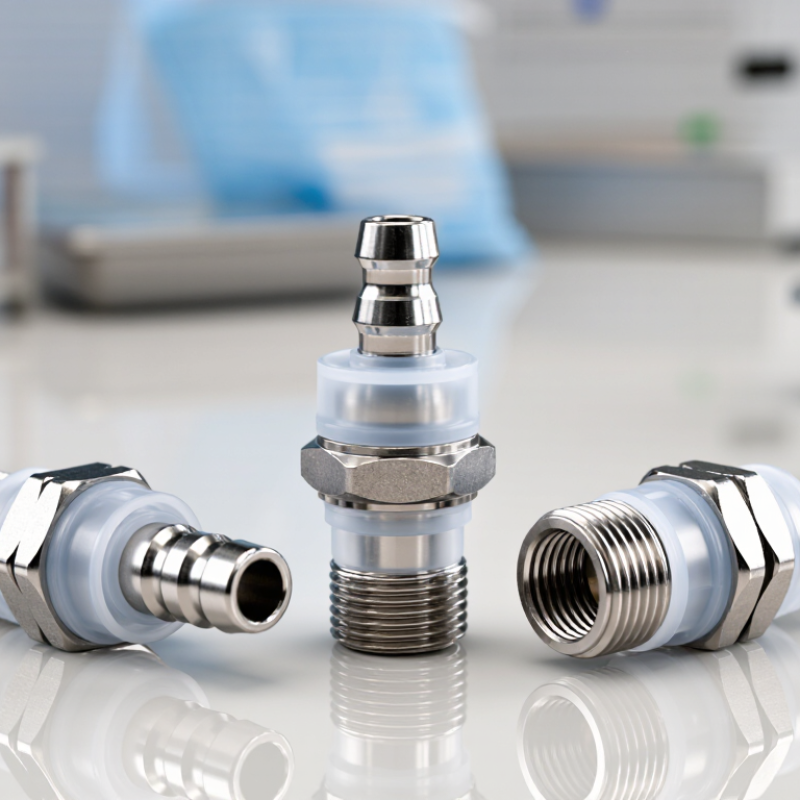
Double male luer lock adapters are small connectors with male threaded luer ends on both sides. They join two female luer ports in a fluid pathway. Their function is simple, but their design affects safety and performance.
When tightened, the threaded collars help secure the connection and reduce accidental separation. The tapered luer surfaces create the fluid seal. These adapters may connect syringes, extension lines, stopcocks, and sampling components. In practical assembly, I check thread engagement by hand before any pressure test. A loose collar can look acceptable. It may still leak.
Material selection also matters. Medical-grade polymers should resist cracking, chemical exposure, and repeated handling when applicable. Dimensions should match recognized luer standards, such as ISO 80369-7, while the complete assembly requires separate validation. Sterility claims must be supported by suitable packaging and documented processing. They should never be assumed from appearance.
Worldwide suppliers should provide drawings, material information, batch traceability, and inspection records. Independent testing for leakage, connection strength, and dimensional accuracy adds confidence. I would also request samples before placing a large order. One overlooked issue is usability: stiff threads can slow clinical preparation, while weak threads may fail during transport. A better evaluation includes gloves, wet surfaces, and realistic tubing movement. “Compatible” is not always precise enough. Supplier communication should identify port geometry, pressure conditions, packaging needs, and intended use.
| Data Dimension | Verified Industry Information | Purchasing and Application Relevance |
|---|---|---|
| Product Definition | A double male Luer lock adapter is a connector with two male Luer ends, each designed to mate with a compatible female Luer port. The locking mechanism helps secure the connection against accidental separation. | Useful for joining two components that both terminate in female Luer ports, such as syringes, extension lines, stopcocks, and other fluid-transfer components. |
| Applicable Connector Standard | Medical Luer connectors are covered by ISO 80369-7, which specifies requirements for small-bore connectors used in healthcare applications involving intravascular or hypodermic connections. Older product documentation may reference ISO 594. | Standards verification helps reduce dimensional mismatch and supports compatibility with regulated medical components. |
| Typical Connection Structure | The adapter normally includes two male tapered Luer tips and external locking threads or threaded collars. The exact thread and collar configuration can vary by design. | Buyers should confirm both end geometry, thread engagement, and sealing performance rather than relying only on the term “Luer compatible.” |
| Common Materials | Common medical-grade material options include polycarbonate, polypropylene, and polyoxymethylene. Material selection depends on chemical resistance, mechanical strength, transparency, and sterilization requirements. | The material must be compatible with the conveyed fluid, cleaning method, temperature range, and required mechanical performance. |
| Primary Function | The adapter provides a detachable, low-volume connection between two female Luer ports while maintaining a fluid pathway through the center of the component. | It is commonly used to extend, redirect, or connect fluid-transfer assemblies without permanently bonding the components together. |
| Typical Applications | Applications may include laboratory fluid handling, medical tubing assemblies, syringe-to-syringe transfer, sampling systems, infusion accessories, and diagnostic equipment. | The intended application determines the required cleanliness level, material, packaging, sterility, and validation documentation. |
| Sterile and Non-Sterile Supply | Double male Luer lock adapters may be supplied sterile or non-sterile. Sterile versions are generally individually packaged and may use validated sterilization processes such as ethylene oxide or irradiation, depending on the product design. | Sterility claims should be supported by packaging information, sterilization validation, shelf-life data, and applicable regulatory documentation. |
| Pressure and Leakage Performance | Pressure capability is product-specific and depends on the material, geometry, mating component, seal design, temperature, and fluid. There is no universal pressure rating for every double male Luer lock adapter. | A supplier should provide tested pressure, leakage, and tensile-separation data for the exact configuration being purchased. |
| Flow Characteristics | Flow is influenced by the internal bore diameter, pathway length, surface finish, and connected components. A smaller internal passage increases resistance and may affect flow rate. | For low-flow, dosing, or pressure-sensitive systems, request internal diameter and flow or pressure-drop test data. |
| Dimensional Verification | Important dimensions include Luer taper geometry, locking-thread engagement, overall length, internal bore, external diameter, and connection alignment. Tolerances should be checked against the applicable drawing or specification. | Dimensional inspection helps prevent leaks, cross-threading, incomplete engagement, and excessive assembly force. |
| Chemical Compatibility | Compatibility varies with the polymer and the fluid. Solvents, lipids, disinfectants, aggressive chemicals, and some drug formulations can cause swelling, stress cracking, embrittlement, or discoloration. | Fluid-specific compatibility testing is recommended before production use, especially for pharmaceutical, laboratory, and chemical applications. |
| Sterilization Compatibility | Resistance to ethylene oxide, gamma irradiation, electron-beam irradiation, steam, or other sterilization methods depends on the material and product construction. Repeated steam exposure may not be suitable for every polymer design. | The selected sterilization process should match the supplier’s validated instructions and the adapter’s intended use. |
| Quality Documentation | For regulated applications, relevant documentation may include material certificates, dimensional inspection reports, biocompatibility information, sterilization records, lot traceability, and a certificate of conformity. | Documentation requirements should be agreed before ordering, particularly for devices used in patient-contact or sterile fluid pathways. |
| Supplier Evaluation Criteria | Key evaluation factors include conformity to applicable standards, manufacturing controls, cleanroom capability, batch traceability, quality-system certification, sample availability, customization support, and production capacity. | A supplier that can provide consistent dimensional control and complete technical records is generally more suitable than one offering only a low unit price. |
| Customization Options | Depending on manufacturing capability, customization may include material selection, color, internal bore, cap or collar design, packaging format, labeling, and connection geometry. | Custom designs should undergo fit, leakage, pressure, material, and usability verification before being released for routine production. |
| Recommended Pre-Purchase Checks | Confirm connector standard, male-to-female mating compatibility, material grade, sterility status, pressure requirement, fluid compatibility, packaging, shelf life, minimum order quantity, and delivery capability. | A documented technical checklist reduces the risk of selecting an adapter that fits mechanically but fails under actual operating conditions. |
Related Posts
-

Understanding the Science Behind Luer Lock Stopcocks: Essential Guide for Medical Professionals
-

How to Use a Luer Lock Stopcock for Safe Fluid Transfer Techniques
-

Why Choose Luer Lock Stopcock for Your Laboratory Needs?
-
Essential Tips for Choosing a Luer Lock Stopcock?
-
5 Tips for Choosing a Double Male Luer Lock Adapter
-
2026 Top Bone Marrow Biopsy Needle Options for Patients and Professionals?